Physics - Grade XI or Standard XI
Chapter 1: Units and Dimensions
Unit:
The reference standard used for the measurement of a physical quantity is called a unit.
Fundamental quantities:
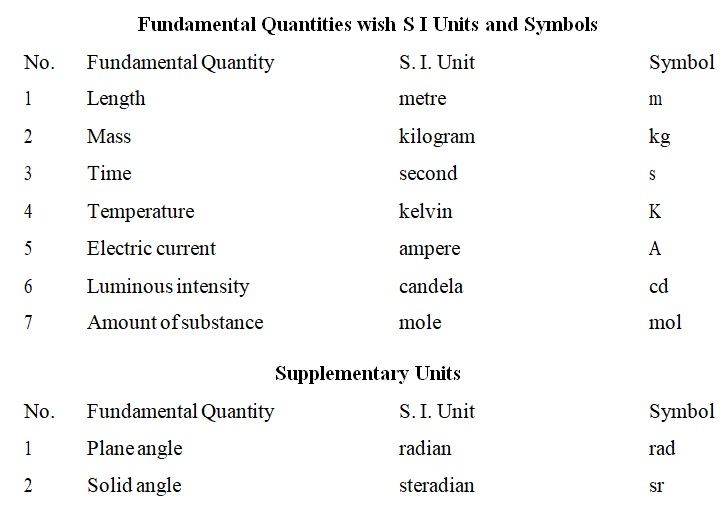
The physical quantities which do not depend on any other physical quantities for their measurements are known as fundamental quantities.
Fundamental units:
The units used to measure fundamental quantities are called fundamental units.
Click Here to Go To Top of The Page
Derived quantities:
The physical quantities other than fundamental quantities which depend on one or more fundamental quantities for their measurements are called derived quantities.
Examples of derived quantities:
force, pressure, density, speed, volume, etc.
Derived units:
The units of derived quantities which depend on fundamental units for their measurements are called derived units.
Examples of derived units:
newton, kg/m3, m/s, etc.
Symbols for Dimensions:
Following symbols are used to denote the dimensions:
L - length, M - mass, T - time, K - temperature, I - current, C - luminous intensity, mol - amount of substance.
Dimensions of a physical quantity:
The dimensions of a physical quantity are the powers to which fundamental units must be raised in order to obtain the unit of a given physical quantity.
Dimensional equation:
An expression, which gives the relation between the derived units and fundamental units in terms of dimensions is called a dimensional equation.
Example of dimensional equations:
Dimensional equation for force = [L1 M1 T-2].
Click Here to Go To Top of The Page
Order of magnitude:
Order of magnitude of a physical quantity is defined as the value of its magnitude rounded off to the nearest integral power of 10.
The magnitude of any physical quantity can be expressed as A × 10n where A is a number such that 0.5 <= A < 5 and ‘n’ is an integer, called order of magnitude.
Example, radius of earth, R = 6400 km = 0.64 × 10⁷ m.
Therefore, order of magnitude of radius of earth is 107 m.
Similarly, order of magnitude for: (a) mass sun is 1030 kg, (b) mass of earth is 1025 kg, (c) mass of an electron = 10-30 kg, (d) distance of sun from earth = 1011 m.
Significant figures or digits:
Generally, the result of measurement is a number that includes all digits in the number that are known reliably plus the first digit that is uncertain. The reliable digits plus the first uncertain digit are known as significant digits or significant figures.
Error:
The difference between the true value and measured value of a physical quantity is called error. Error may be positive or negative.
Mean value:
The arithmetic mean of good number of readings is called mean value.
Click Here to Go To Top of The Page
Absolute error:
The magnitude of the difference between mean value and each individual value is called an absolute error.
Mean absolute error:
The arithmetic mean of all the absolute errors is called a mean absolute error.
Relative error:
The ratio of the mean absolute error in the measurement of a physical quantity to its most probable value is called a relative error.
Percentage error:
The relative error multiplied by 100 is called the percentage error.
Instrumental errors:
The errors caused due to faulty instruments are called instrumental errors.
Systematic or persistent errors:
The errors caused due to defective setting of an instrument are called systematic or persistent errors.
Personal errors:
The errors caused due to faulty procedure of an experimenter are called personal errors. Random or accidental errors : The errors caused due to various factors like change in tempera- ture, pressure, or fluctuation in voltage, etc. are called random or accidental errors.
Click Here to Go To Next Page Click Here to Go To Previous Page Click Here to Go To Top of The Page